

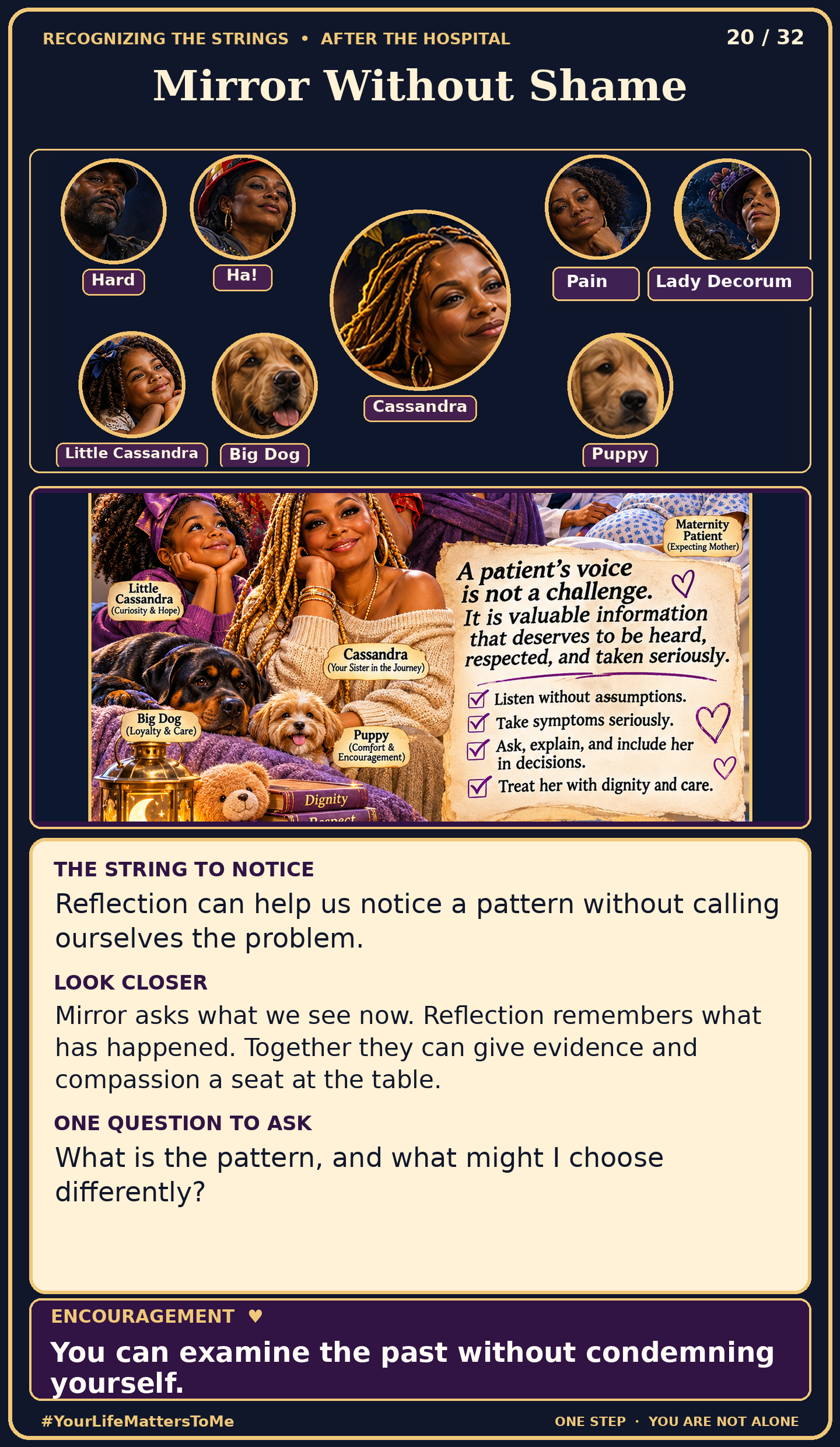
Card 20 — Mirror Without Shame Reflection helps us notice a harmful pattern without declaring the person who learned it beyond growth.
🎬 Today’s illustrated recognition cards
Saturday’s imaginary hospital scene puts inherited assumptions before Mirror, Should, and What Had Happened Wuz for careful examination rather than instant condemnation.
Beloveds,
Welcome to our Saturday noon reflection. Today, instead of claiming we watched a particular film, I want to examine an imagined scene that could teach us something about the way stories are told.
Our Saturday reflection examines an especially quiet string: the old stories we inherit about who is strong, who is difficult, and whose concerns deserve more attention.
Picture a hospital room. A Black mother tells the team her pain is getting worse. A family member notices she is struggling. One person asks for another assessment. Another person glances at the chart and says everything looks fine.
The camera could follow the busiest professional in the room. Or it could stay with the woman whose body is telling her something has changed.
The second choice is important. Too many stories make patients into background characters while other people narrate what is happening to them.
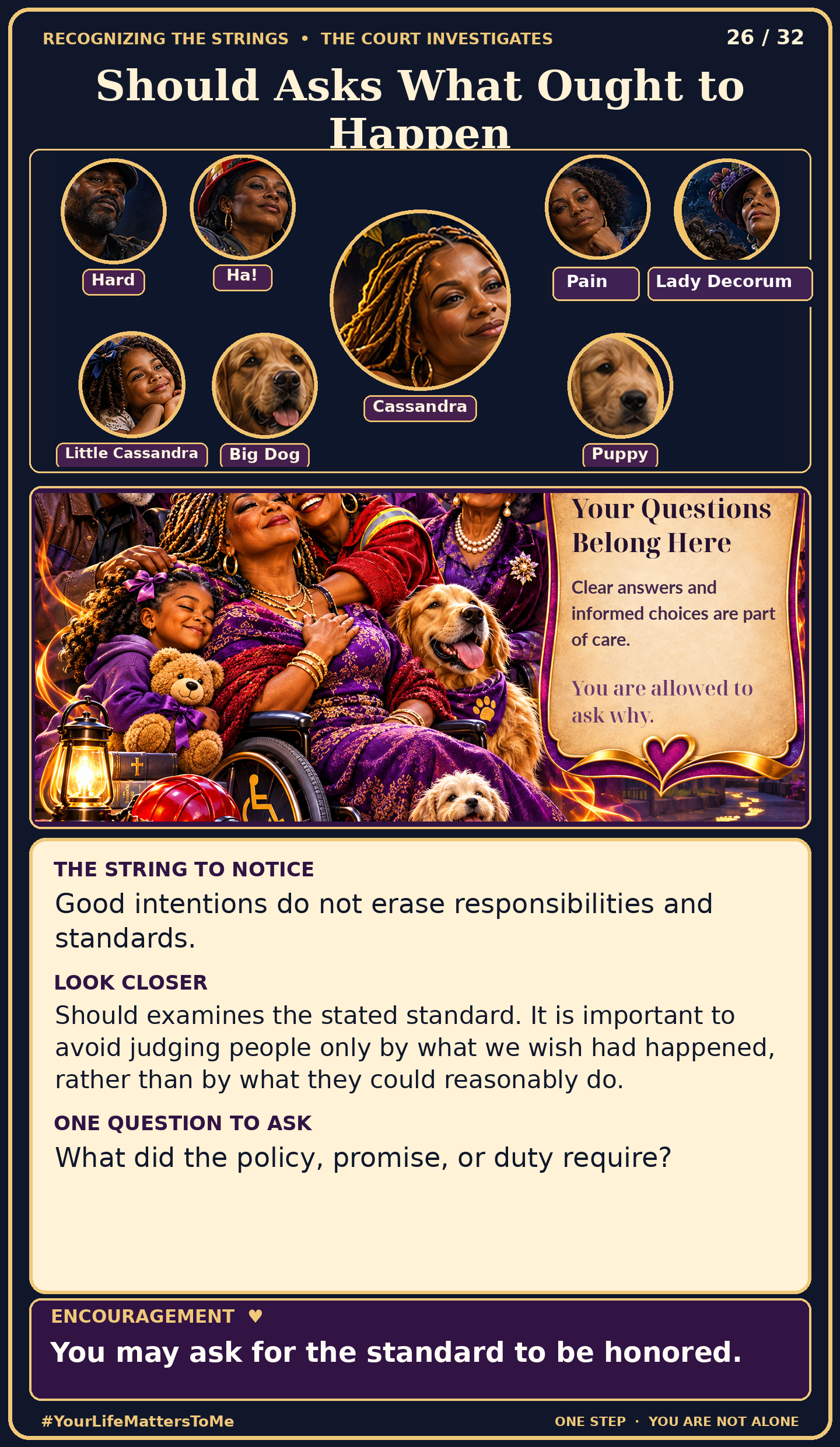
Card 26 — Should Asks What Ought to Happen Standards matter: what were patients promised, what was required, and what should responsible care include?
Now imagine the scene rewritten. The clinician stops, asks what has changed, checks for serious causes, explains the next steps, and returns to reassess. The patient gets an opportunity to ask questions and describe what matters to her.
That does not promise a perfect outcome. It demonstrates a better process.
Our real-world evidence tells us this is worth examining: a CDC maternity-care survey documented mistreatment and discrimination, with Black respondents reporting disproportionately negative experiences. That finding should challenge institutions to listen, learn, and improve.
The woman is not the supporting character in her own medical encounter. Neither is the girl she once was, the daughter who loves her, or the family member trying to help.
Beloveds, we can ask for a different scene without inventing a villain in every hospital room.
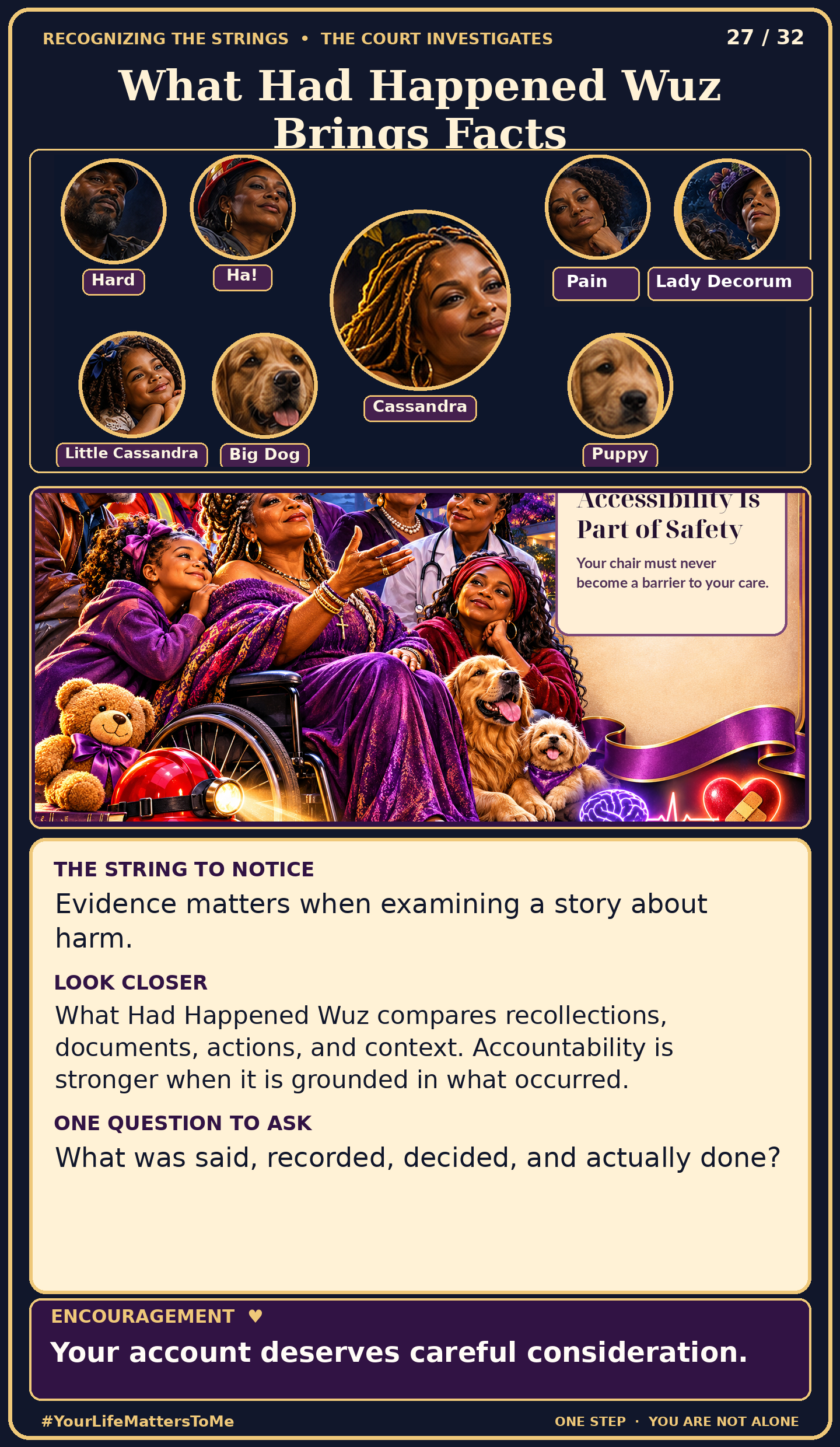
Card 27 — What Had Happened Wuz Brings Facts Before we assign motives, examine what actually occurred and whose experience has been left out of the record.
🔦 Recognizing the String
In our imagined hospital scene, “She’s strong; she’ll be fine” might be intended as praise. But if that belief leads someone to minimize worsening pain, the expectation has become a string. The person affected should not have to prove the danger in order to be heard.
The string is an inherited assumption. Families, professions, and institutions may repeat ideas without remembering where they began. Recognition does not automatically make everyone a villain; it asks what was assumed, what was overlooked, and who bore the cost.
Mirror and Reflection investigate the words without turning reflection into shame. Should examines what the standard required; What Had Happened Wuz asks what actually happened. Both are necessary before drawing conclusions.
In the rewritten scene, the clinician asks what has changed, assesses for serious problems, explains the plan, and returns to reassess. Seeing the string is the first step; changing how care is delivered is the next.
One step. You are NOT alone.
A question for our Beloveds: What familiar assumption deserves examination before we pass it along to someone else?
loving me some you
Cassandra
#YourLifeMattersToMe ❤️
Read further: CDC maternity-care experiences survey
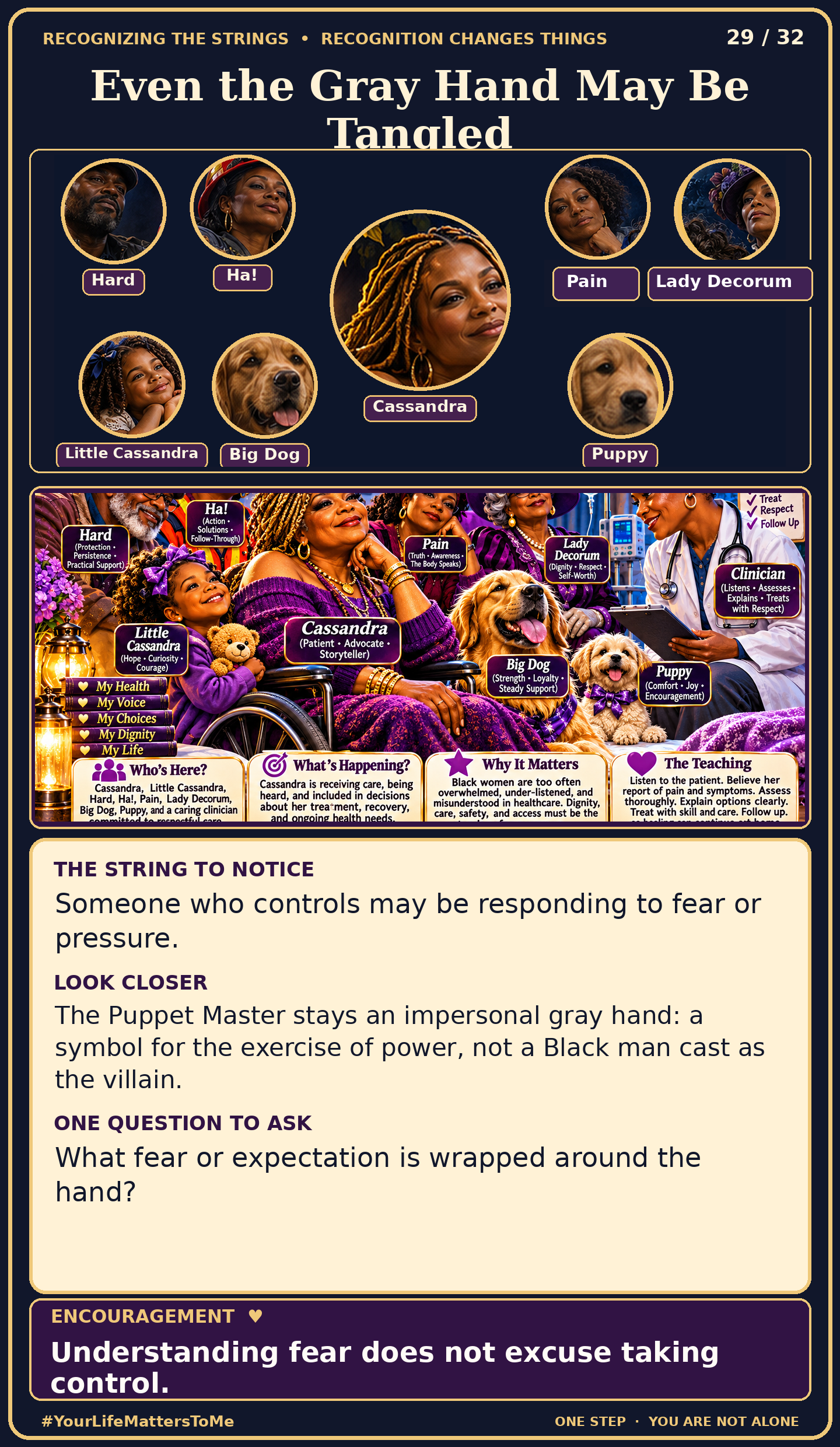
Card 29 — Even the Gray Hand May Be Tangled Fear and expectations may constrain the person exercising power, but understanding those forces does not excuse harm.


